
New website launch for Mr Daniel Dowen
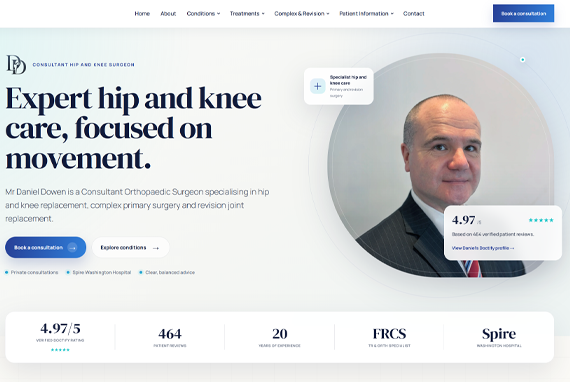
Phast Media has launched a new custom WordPress website for Mr Daniel Dowen, a consultant hip and knee surgeon. The project focused on specialist positioning, clear patient pathways, structured treatment content and long-term search visibility.
A new consultant website built around clarity and movement
Phast Media has launched a new website for Mr Daniel Dowen, a consultant orthopaedic surgeon specialising in hip and knee surgery. The website was planned as a full specialist digital presence, not simply a small brochure site.
The aim was to create a website that feels professional, modern and clinically credible, while still being warm and accessible for patients. It needed to explain Daniel’s areas of expertise clearly, support private patient enquiries and provide useful information for people researching hip and knee problems.
The finished website combines consultant positioning, patient-friendly content, custom-coded WordPress layouts and a structured SEO foundation.
This type of project shows how specialist healthcare websites need to balance trust, usability, search visibility and personality. Patients need clear information, but they also need reassurance that they are in the right place.
Building more than a consultant profile
Many consultant websites rely heavily on a biography, a list of treatments and a contact page. For this project, the goal was broader. The website needed to help patients understand symptoms, conditions, procedures, complex surgery, revision surgery and the consultation journey.
It also needed to communicate Daniel’s specialist focus without making the site feel too clinical or difficult to navigate, with a clear About page to explain his background, expertise and approach.
Clearly present Daniel’s expertise in hip and knee surgery, including complex and revision work.
Guide users from symptoms and conditions through to relevant treatments and consultation routes.
Use structured content, photography and visual detail to support trust and authority.
Create a page structure that supports organic visibility for relevant orthopaedic searches.
The result is a site that works both as a consultant introduction and as a useful decision-support resource for patients.
A visual direction based on movement, confidence and specialist care
The design direction was shaped around movement and recovery, rather than a generic clinical look. For an orthopaedic surgeon specialising in hip and knee surgery, this felt important. The website needed to connect clinical expertise with the real-life outcome patients are often looking for: getting back to moving with confidence.
The visual style uses a refined colour palette, clear typography, structured content sections and carefully placed imagery. The aim was to create a website that feels polished and specialist, while still being easy to understand.
| Design decision | Why it mattered | Result |
|---|---|---|
| Movement-led creative direction | Hip and knee surgery is closely connected to mobility, independence and return to activity. | The site feels more human and less like a standard clinic template. |
| Clear content cards | Patients often need to compare conditions, treatments and next steps. | Information is easier to scan and navigate. |
| Strong visual hierarchy | Detailed medical content needs to be organised carefully. | Pages feel structured rather than overwhelming. |
| Consistent calls to action | Patients need clear routes to booking and contact information. | The enquiry journey feels more direct and less confusing. |
The design was built to feel premium and professional, but not cold. In healthcare website design, that balance matters.
Creating clearer routes through conditions and treatments
One of the key parts of the project was structure. Patients do not all arrive on a website in the same way. Some search for knee pain. Others search for hip replacement. Others may already know they need revision surgery or want a consultant with experience in complex cases.
The website was planned around these different journeys, with clear sections for conditions and treatments, complex and revision surgery, patient information and consultation routes.
Helpful pages for users researching symptoms, causes and possible next steps.
Structured pages for procedures such as hip and knee surgery.
Dedicated positioning for more specialist and complex orthopaedic work.
Clearer explanation for patients researching previous joint replacement problems.
Practical support content to help users understand appointments, preparation and recovery.
Prominent routes to consultation and contact pages throughout the site.
This kind of structure helps users find the most relevant information quickly. It also helps search engines understand the relationship between the consultant, the services and the conditions treated.
A custom WordPress build designed for structure and future growth
The website was built in WordPress using custom-coded layouts and a tailored front-end design system. This approach gives the site the flexibility of WordPress while allowing the design, content structure and user journey to be shaped around the project rather than forced into a generic template.
For a consultant website with a broad launch scope, reusable patterns are important. Treatment pages, condition pages, patient information pages and related content all need to feel connected, consistent and easy to expand.
| Technical focus | What we considered | Why it helps |
|---|---|---|
| Custom WordPress layouts | Flexible page structures tailored to healthcare content. | Allows pages to feel bespoke while remaining manageable. |
| Reusable design patterns | Consistent cards, CTAs, intro blocks and related links. | Keeps the site coherent as more content is added. |
| Responsive presentation | Layouts tested for desktop, tablet and mobile reading. | Patients can access key information from any device. |
| Internal linking structure | Connections between conditions, treatments, patient information and contact routes. | Improves navigation and supports SEO clarity. |
| Schema-ready content | Pages structured with clear headings, FAQs and entity-rich information. | Supports search engines and AI systems in understanding the website. |
The goal was not just to launch a polished site, but to create a foundation that can continue to support content growth, search visibility and patient enquiries over time.
Building search visibility into the page structure
For specialist healthcare websites, SEO should not be an afterthought. The site needs to be planned around the way people search, the language they use and the information they need before making contact.
The Daniel Dowen website uses a structured approach to conditions and treatments, with dedicated content for key patient searches and supporting patient information. This gives the website more opportunities to appear for relevant searches and helps users move from research to enquiry.
Strong healthcare SEO starts with useful structure: clear services, clear conditions, clear questions and clear routes to the next step.
This approach also supports AI discoverability. Clear page titles, headings, FAQs, internal links, consultant context and service-specific language all help the website explain itself more effectively to search engines and AI-driven systems.
For more on this wider approach, read our guide to useful content for healthcare SEO.
What this project says about consultant website design
The Mr Daniel Dowen website is a good example of how consultant websites have moved beyond basic online CVs. Patients, referrers and search engines all need more useful structure than a traditional brochure website usually provides.
A stronger consultant website should explain expertise, support patient decision-making, provide clear routes through conditions and treatments, and give the practice a platform for long-term digital growth. The live site shows this through Daniel’s consultant profile, condition and treatment content, and simple consultation pathway.
The best consultant websites do not simply present credentials. They help people understand, trust and take the next step.
For Phast Media, this project reflects the kind of specialist healthcare website work we enjoy most: combining strategy, design, WordPress development, SEO, content structure and practical enquiry pathways into one focused digital presence.
You can also explore more of our work in healthcare marketing and consultant website design.
Consultant website design FAQs
What makes a consultant website different from a standard business website?
A consultant website needs to combine professional credibility, patient-friendly information, clear service pathways, strong biography content, enquiry routes and search-friendly structure. It should help users understand both the consultant and the care pathway.
Why is structure important for a healthcare website?
Structure helps patients find the right information quickly. It also helps search engines understand the relationship between conditions, treatments, services, locations and the consultant’s expertise.
Should consultant websites include condition and treatment pages?
Yes, where relevant. Condition and treatment pages help users understand their options and give the website stronger opportunities to appear for useful search terms. They should be written clearly and responsibly.
Can a consultant website be built in WordPress?
Yes. WordPress can be a strong platform for consultant websites when the design, content structure and front-end layouts are tailored properly. A custom-coded WordPress approach can provide flexibility, search-friendly content management and room for future growth.
Can Phast Media build websites for consultants and clinics?
Yes. Phast Media works on consultant, clinic and specialist healthcare websites, combining strategy, website design, WordPress development, SEO, content structure and ongoing digital support.
Planning a consultant or specialist healthcare website?
Phast Media can help with strategy, custom WordPress website design, content structure, SEO, patient pathways, enquiry routes and ongoing digital support.